
Back Pain, Ten Years On - Book By Adam Gavine Review
Back Pain, Ten Years On
AUTHOR UPDATE · SEPTEMBER 2026
By By Dr Adam Gavine, BHK, M.Chiro
Published 3 September 2026
When Dr Rod Bonello and I wrote Back Pain: How to Build Core Stability for Long-Lasting Relief, our aim was straightforward: give people a practical way to understand their back, make sense of the treatment choices in front of them and take a more active role in recovery.
The book was published by Allen & Unwin in 2014. More than a decade later, people still contact me because they bought it, borrowed it from a library, worked through the exercises or have only recently come across it. This article is for all of them.
It is not simply a review of our own book. It is a bridge between what we wrote then and what higher-quality research now tells us about back pain, physical rehabilitation and long-term self-management.
My short answer is this: the book’s central message—that people generally do better when they understand their condition, rebuild physical capacity and participate actively in their recovery—has aged well. What has changed is the language and the precision. Today, I would place less emphasis on “core stability” as a stand-alone answer and more emphasis on individualised movement, progressive loading, confidence, sleep, stress, general health and the person’s own goals.
Why we wrote the book
Back pain can affect far more than the back. It can change how you sleep, work, train, drive, parent and socialise. When pain persists, it is easy to become trapped between conflicting advice: rest but stay active; protect your spine but do not fear movement; strengthen your core but do not brace all day; get a scan but do not overinterpret it.
Rod and I wanted to make anatomy and rehabilitation understandable without pretending that every reader had the same diagnosis. We explained spinal structures, common causes and presentations, assessment, treatment options and home-based exercises. We also tried to help readers ask better questions of the practitioners treating them.
That last point remains especially important. A useful back-pain plan should not be something done to you indefinitely. It should help you understand what is happening, what can be changed and how to become less dependent on care over time.
Book overview
Back Pain is a 248-page illustrated self-help and rehabilitation guide written by Dr Adam Gavine and Dr Rod Bonello. It combines accessible spinal anatomy, discussion of common back-pain presentations, an overview of diagnostic and treatment approaches, advice on choosing a practitioner, and photographed rehabilitation exercises that can be performed at home.
The book is written for people who want to understand their symptoms and engage more actively in recovery, as well as readers hoping to reduce the likelihood of future episodes. It is educational rather than a substitute for an individual diagnosis or rehabilitation plan.
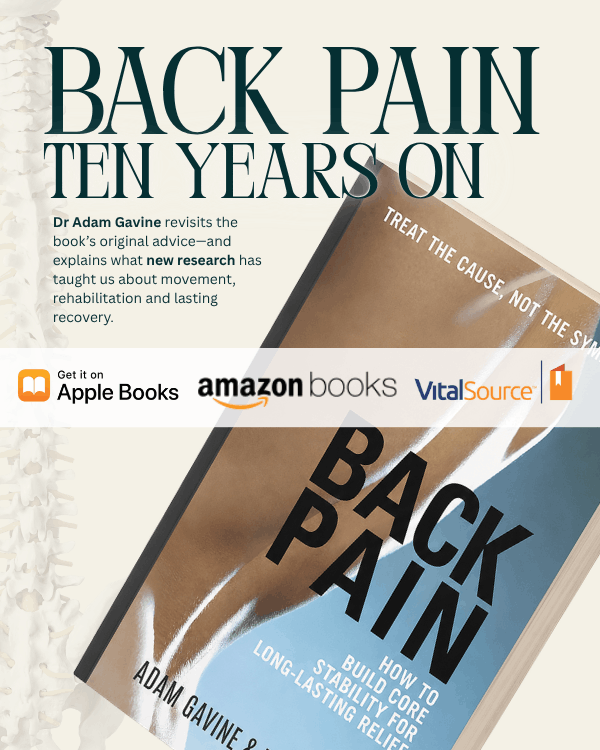
Publication details
Full title: Back Pain: How to Build Core Stability for Long-Lasting Relief
Authors: Adam Gavine and Rod Bonello
Publisher: Allen & Unwin
First edition: 2014
Language: English
Print length: 248 pages
Paperback ISBN-10: 1743317123
Paperback ISBN-13: 978-1743317129
eText ISBN: 9781743436899
Paperback dimensions: 6 × 0.8 × 9 inches
Table of contents
The publisher lists the book’s principal sections as:
Preface
Guide to the rehabilitation exercises
Anatomy
Causes of back pain
Diagnosis of back pain
Treatment
How to choose a practitioner
The detailed opening contents supplied with the digital edition begin as follows:
Cover page
Title page
Copyright page
Dedication
Contents
Preface
Introduction
Guide to the rehabilitation exercises
Anatomy
Spinal column
Spinal curves
Vertebrae
Spinal cord
Meninges
Intervertebral disc
Annulus fibrosus
Nucleus pulposus
Vertebral endplates
Disc nerve supply
Facet joints
Muscles
Fascia
Sacroiliac joints
My Back Pain Story—Drew Ginn
That structure reflects the book’s intention: first understand the body and the possible sources of symptoms, then consider assessment and treatment, and finally put rehabilitation into practice.
What still holds up after more than a decade
1. Active rehabilitation matters
The strongest idea in the book was not a particular exercise. It was that recovery usually requires active participation.
A 2021 Cochrane review of 249 trials found moderate-certainty evidence that exercise probably improves pain in chronic low-back pain compared with no treatment, usual care or placebo.[1] The effect varies between individuals and programs, but the direction is consistent with what I see clinically: appropriate movement and gradually restored capacity are generally more useful than waiting for the back to become “perfect” before using it.
2. Education should reduce fear, not create it
Anatomy is useful when it helps someone understand their body. It is not useful when it leaves them believing their spine is fragile, misaligned or one ordinary movement away from damage.
Pain is real, but pain does not provide a direct measure of tissue damage. It is influenced by the irritated tissues, nervous system sensitivity, previous experiences, beliefs, stress, sleep, general health and the demands being placed on the body. Explaining this well does not dismiss pain as psychological. It gives us more practical levers to work with.
The World Health Organization’s 2023 guideline for chronic primary low-back pain recommends person-centred, coordinated care that considers the mixture of physical, psychological and social factors affecting the individual.[2]
3. Self-management remains the long-term goal
Hands-on care may help some people manage pain and move more comfortably, particularly when it is combined with advice and exercise. But passive treatment alone rarely builds the confidence, tolerance and physical capacity needed for lasting independence.
This is why my current approach at Back to Function Chiropractic is assessment-led. Treatment is one part of the plan, not the entire plan. The objective is to help each patient return to meaningful activity and understand how to manage future fluctuations.
What I would explain differently today
Core stability is a tool—not a universal diagnosis or cure
The phrase “core stability” was widely used when we wrote the book, and trunk strength and control remain relevant. For some people, learning to coordinate the abdominal, spinal, pelvic and hip musculature is genuinely useful. For others, the more important need may be endurance, hip or thoracic mobility, confidence with bending, lifting technique, whole-body strength, walking tolerance or simply permission to move normally again.
I would no longer want a reader to conclude that back pain automatically means the core is weak, that one deep abdominal muscle has “switched off,” or that the spine must be held rigidly in a neutral position. Constant guarding can sometimes become part of the problem.
Current evidence supports exercise, but it does not identify one universally superior exercise system for chronic low-back pain. The practical question is not “What is the perfect back exercise?” It is “What activity can this person perform safely, progressively and consistently enough to improve the abilities that matter to them?”
Rehabilitation should be individualised
Two people can have similar scan findings and very different symptoms. Two people with the same pain score may have entirely different barriers to recovery. One may need graded exposure to lifting; another may need sleep and workload changes; another may need to rebuild general fitness after months of avoiding activity.
The Australian RESTORE trial illustrates this change in thinking. Conducted in 20 physiotherapy clinics with researchers from Curtin University, the University of Western Australia and Macquarie University, the trial enrolled 492 adults with chronic, disabling low-back pain. Cognitive functional therapy—an individualised approach addressing pain beliefs, emotions, behaviours and movement—produced larger and more sustained improvements in activity limitation than usual care at 12 months.[3]
The 2025 three-year follow-up found that these benefits remained. Participants had received up to seven sessions over 12 weeks and one booster session; adding movement-sensor biofeedback did not produce a meaningful advantage over the individualised therapy alone.[4] That does not mean one named therapy is right for everyone. It does reinforce the value of personalised education, movement practice and behaviour change over a generic protocol.
Walking deserves more attention
One of the most practical Australian findings of the past decade came from Macquarie University’s WalkBack trial. Researchers recruited 701 adults across Australia who had recovered from an episode of non-specific low-back pain. An individualised, progressive walking and education program reduced the risk of an activity-limiting recurrence by 28%. The median time to recurrence was 208 days in the intervention group, compared with 112 days in the control group.[5]
Walking is not a cure for every back condition. It is, however, accessible, inexpensive and easy to scale. The lesson is not that everybody must immediately walk for 30 minutes five days a week. It is that a tolerable starting dose can be increased progressively according to fitness, symptoms and confidence.
Imaging has a specific role
Scans can be essential when a serious underlying condition is suspected, progressive neurological loss is present, or imaging will change management. They are not automatically required for uncomplicated low-back pain.
Australian research has documented both overuse of imaging when it is not indicated and underuse when it is.[6] The Australian Commission on Safety and Quality in Health Care’s Low Back Pain Clinical Care Standard recommends a thorough initial assessment, screening for serious causes and a more active approach to recovery rather than routine reliance on imaging, bed rest, medication or invasive treatment.[7]
A scan finding also needs clinical context. Age-related changes are common, including in people who do not have pain. Treating an image instead of the person can create unnecessary fear and lead care in the wrong direction.
How I suggest using the book today
If you already own Back Pain, I would not tell you to discard it. I would use it as a foundation, with five modern qualifications:
Use the anatomy to become informed, not alarmed. Structures matter, but a structural label rarely explains the complete pain experience.
Treat the exercise section as a menu, not a mandatory sequence. Your starting point, technique, dosage and progression should reflect your presentation and goals.
Do not judge an exercise only by whether you feel absolutely no discomfort. Some rehabilitation can involve tolerable, temporary symptoms. Sharp, escalating or neurologically concerning symptoms warrant reassessment.
Build beyond the core. Walking, aerobic fitness, whole-body strength, balance, sleep and gradual return to work or sport may all belong in the plan.
Seek individual assessment when the picture is unclear. A book cannot examine strength, sensation, reflexes, movement, load tolerance or red flags.
If you are currently dealing with back pain, you may also find our pages on chiropractic care, treatments, fees and appointments useful.
When to seek prompt medical assessment
Most back pain is not caused by a dangerous condition, but some symptoms should not be managed from a book or exercise video alone. Seek prompt medical assessment if back pain follows significant trauma or occurs with:
new loss of bladder or bowel control
numbness in the saddle or genital area
severe or progressive weakness in one or both legs
fever, unexplained weight loss or feeling systemically unwell
a history of cancer, significant immune suppression or serious infection risk
severe, unremitting pain that is rapidly worsening or unlike your usual symptoms
If symptoms are severe or you believe you may be experiencing an emergency in Australia, call Triple Zero (000).
Where to read or buy Back Pain
Availability and pricing vary by country and format. These links were checked in September 2026:
What readers have said
The published reader feedback is limited in volume, so I would not overstate it. At the time of review, Amazon displayed a 4.8-out-of-5 rating based on five ratings. One reader who had experienced recurring, debilitating low-back pain described the book as especially useful because it brought anatomy, causes, diagnosis and treatment together in one place. Another said it had been recommended by their therapist and offered a helpful insight into back pain.
Those comments mean a great deal to me because comprehensiveness and practical usefulness were exactly what Rod and I were trying to achieve. They are personal experiences, however—not clinical evidence or a guarantee that the book’s approach will suit every reader.
My view, more than ten years later
If I were writing Back Pain from scratch today, it would still contain anatomy, assessment, treatment choices and exercise. It would still encourage readers to become active participants rather than passive recipients of care.
But I would broaden the title’s promise. Long-lasting improvement is not simply about switching on the right muscle. It is about rebuilding trust in the body, restoring useful movement and physical capacity, understanding flare-ups, addressing the factors that keep pain going, and developing a plan that can adapt to real life.
The reassuring message from the past decade of research is not that we have discovered one perfect treatment. It is that many people can improve through a thoughtful, progressive and individualised approach—and that relatively simple tools, including education, walking and well-chosen exercise, can make a meaningful difference.
If your back pain is persistent, recurrent or stopping you from doing what matters, the next useful step is a proper assessment. You can book an initial chiropractic consultation at Back to Function Chiropractic to discuss your history, examination findings and appropriate care options.
About the author
Dr Adam Gavine, BHK, M.Chiro, is a chiropractor with a special interest in sports medicine, movement assessment and spinal and functional rehabilitation. A former Canadian decathlete, he has worked with athletes and active people across a broad range of sporting and everyday presentations. He is the co-author, with Dr Rod Bonello, of Back Pain: How to Build Core Stability for Long-Lasting Relief and practises at Back to Function Chiropractic in NSW, Australia.
Medical disclaimer
This article provides general health information only. It does not replace individual medical or healthcare advice, diagnosis or treatment. Back pain has many possible causes, and exercises or management strategies should be selected according to your history, examination findings, health status and goals. Consult a qualified health practitioner about your circumstances. In an emergency in Australia, call Triple Zero (000).
References
Hayden JA, Ellis J, Ogilvie R, Malmivaara A, van Tulder MW. Exercise therapy for chronic low back pain. Cochrane Database Syst Rev. 2021;9(9):CD009790. doi:10.1002/14651858.CD009790.pub2
World Health Organization. WHO Guideline for Non-surgical Management of Chronic Primary Low Back Pain in Adults in Primary and Community Care Settings. World Health Organization; 2023. Accessed September 3, 2026. https://www.who.int/publications/i/item/9789240081789
Kent P, Haines T, O'Sullivan P, et al; RESTORE Trial Team. Cognitive functional therapy with or without movement sensor biofeedback versus usual care for chronic, disabling low back pain (RESTORE): a randomised, controlled, three-arm, parallel group, phase 3 clinical trial. Lancet. 2023;401(10391):1866-1877. doi:10.1016/S0140-6736(23)00441-5
Hancock M, Smith A, O'Sullivan P, et al. Cognitive functional therapy with or without movement sensor biofeedback versus usual care for chronic, disabling low back pain (RESTORE): 3-year follow-up of a randomised, controlled trial. Lancet Rheumatol. 2025;7(11):e789-e798. doi:10.1016/S2665-9913(25)00135-3
Pocovi NC, Lin CWC, French SD, et al. Effectiveness and cost-effectiveness of an individualised, progressive walking and education intervention to prevent low back pain recurrence in Australia (WalkBack): a randomised controlled trial. Lancet. 2024;404(10448):134-144. doi:10.1016/S0140-6736(24)00755-4
Jenkins HJ, Downie AS, Maher CG, et al. Imaging for low back pain: is clinical use consistent with guidelines? A systematic review and meta-analysis. Spine J. 2018;18(12):2266-2277. doi:10.1016/j.spinee.2018.05.004
Australian Commission on Safety and Quality in Health Care. Low Back Pain Clinical Care Standard. Australian Commission on Safety and Quality in Health Care; 2022. Accessed September 3, 2026. https://www.safetyandquality.gov.au/resources/low-back-pain-clinical-care-standard-2022
Health information notice: This article provides general educational information and does not replace individual healthcare advice, diagnosis or treatment.
